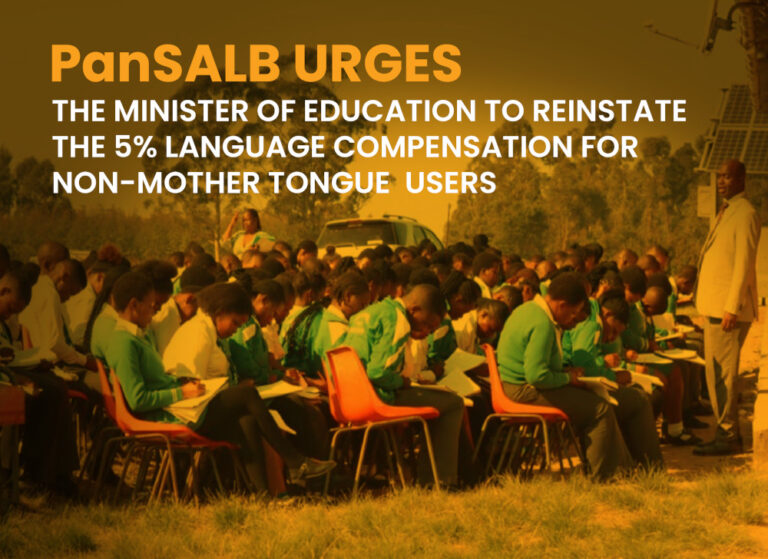
The Pan South African Language Board urges the Minister of Education, Honourable Siviwe Gwarube and uMalusi, the Quality Assurance in General and Further Education and Training, to reinstate the 5% language compensation policy that was previously extended to learners whose home language differed from the language of teaching and learning (LoLT). This mechanism, introduced in 2000, involved adding up to 5% marks in non-language subjects for qualifying learners, aiming to account for linguistic barriers without altering the raw exam performance. The rationale was rooted in extensive evidence showing that proficiency in the LoLT is a major factor influencing academic performance. It has been scientifically proven that learners taught in a second language often struggle with comprehension, leading to lower achievement in content subjects like Mathematics and Science. The consequence of this deficiency is rote learning which is memorizing information through repetition without necessarily understanding the underlying concepts, focusing on verbatim recall rather than deep comprehension or critical thinking.
This language compensation initiative, although it never directly addressed the LoLT challenge for the majority of South Africans in the education sector, it was rightfully intended as a measure to bridge gaps while broader language policies within the education sector evolved. PanSALB views the phased withdrawal of the policy (which was reduced to 3% by 2016) and fully discontinued from the 2023 National Senior Certificate cohort as premature. This withdrawal is not informed by any scientific study that concludes the matric national examinations’ language compensation purpose has been addressed. It is PanSALB’s view, therefore, that this withdrawal assumes that language policies that have been adopted to address challenges of teaching and learning in the mother tongue have been fully implemented and are effectively applied nationwide.
On the contrary, the use of indigenous African languages as LoLT was only introduced in 2025 from Grade 4, to be incrementally continued to higher grades each year. It would be on the full implementation of the policy provisions governing the use of indigenous African languages as LoLT that this withdrawal would make sense, as the challenges that necessitated its introduction would have been addressed. The withdrawal perpetuates the systemic injustices of Bantu and Apartheid education systems, where blacks and native speakers of indigenous African languages were taught in languages they have no full comprehension of.
PanSALB has taken note of various concerns and confusion that still plague the full implementation of Mother Tongue-based Bilingual Education (MTbBE) programme. It is in constant engagements with the Department of Basic Education around issues related to terminology standardisation and other challenges affecting the implementation of the programme. The language compensation policy must be implemented to assist those writing in a foreign language until the MTbBE policy matures, where all would receive equal education and write matric national examinations in the language they best comprehend, as a language right enshrined in the Constitution.
In light of these realities, PanSALB call on the Minister and uMalusi to reconsider the withdrawal of the 5% language compensation to level the playing field for learners whose home language is not yet fully implemented as a language of learning and teaching, thereby fostering a more inclusive educational framework until comprehensive multilingual policies are uniformly realized. PanSALB advocates for an education system that does not discriminate against any language, where there would not be a need for language compensation. The Minister and Umalusi are therefore invited to join PanSALB in its mission of advocating for multilingual education, where it is not only Afrikaans and English that are effectively recognised in our matric national examinations, as was the case during the apartheid regime. PanSALB’s shall be understood as including a duty to prevent the use of any language for exploitation, domination or division. In this context, English and Afrikaans are systemically sustaining their exclusive hegemony infringing section 9 of the Constitution that such discrimination on the basis of language shall be prevented.
ABOUT PanSALB
The Pan South African Language Board (PanSALB) is a constitutional body mandated to create conditions for the recognition, implementation and furtherance of multilingualism in the Republic of South Africa; and the development of previously marginalised languages.