As artificial intelligence, digital platforms, and changing media consumption habits reshape how societies communicate, an important question confronts South Africa: How do we ensure that indigenous languages remain visible, relevant, and influential in the digital age?
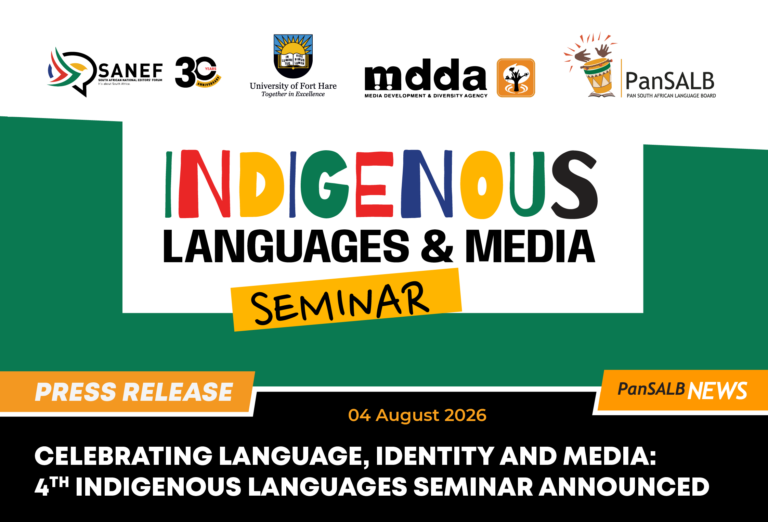
It is against this backdrop that the South African National Editors’ Forum (SANEF), in partnership with the Pan South African Language Board (PanSALB), the University of Fort Hare, and the Media Development and Diversity Agency (MDDA), will host the 4th Indigenous Languages and the Media Seminar on Thursday, 13 August 2026, at the University of Fort Hare’s East London (kuGompo) Campus in the Eastern Cape.
Held under the theme, “Rooted in Language: Indigenous Media as a Platform for Belonging and Cultural Continuity,” the seminar will bring together journalists, editors, academics, language practitioners, policymakers, students, community media representatives, and government stakeholders to explore the future of indigenous languages in South Africa’s rapidly evolving media environment.
Now in its fourth year, the seminar has established itself as a leading platform for dialogue on the role of media in ensuring indigenous languages remain visible, relevant and sustainable. It provides a space to share research, showcase innovation, interrogate emerging challenges, and identify practical strategies to ensure indigenous-language media remains sustainable, accessible, and impactful for generations to come.
This year’s discussions will focus on two key sub-themes:
Indigenous Languages and the Digital Media Conundrum
Indigenous Language Media: Promotion and Preservation
Participants will grapple with how artificial intelligence, technological disruption, evolving audience behaviours, and economic pressures are reshaping the future of indigenous-language journalism and content production. The seminar will also explore how media and educational institutions, language bodies, and policymakers can collaborate to strengthen indigenous-language journalism and content production.
At a time when debates about identity, inclusion, representation, and social cohesion are increasingly prominent, indigenous languages remain central to South Africa’s democratic and cultural future. The seminar seeks to advance meaningful dialogue on how media can contribute to linguistic diversity while ensuring that indigenous language speakers are fully represented in public discourse.
SANEF Executive Director Reggy Moalusi said the seminar continues to serve as a vital platform for addressing the challenges facing indigenous language media while celebrating its role in strengthening democracy and cultural identity.
“Language is more than a means of communication; it is a repository of culture, memory, knowledge, and belonging. The media has a critical responsibility to ensure that indigenous languages remain visible, relevant, and valued across all platforms. This seminar allows us to collectively explore innovative ways of securing the future of indigenous language journalism in South Africa.”
The PanSALB Chief Executive Officer, Dr Keaobaka Seshoka, reiterated the need for the media sector to further multilingualism in the country. “Historically, the media has played a critical role in the development, promotion and preservation of indigenous African languages. Our objective is to honour this legacy and revitalise the relationship between language and the media, ensuring that citizens can access information in their own languages. The media is essential in supporting participatory democracy, and through this seminar, we seek to reaffirm its role in advancing multilingualism. The ultimate outcome we are striving for is the creation of an ecosystem that begins with the effective implementation of multilingual education policies within our education system and culminates in multilingual newsrooms that reflect the rich linguistic diversity of our country”.
UFH acting Deputy Vice-Chancellor: Research, Partnerships and Innovation, Prof Neil Roos, said the seminar reflects the University’s longstanding commitment to scholarship that engages with the languages, histories, and lived experiences of African communities.
“UFH has a storied heritage and is committed to redress, justice and inclusion. Indigenous languages form part of its historical identity and the foundations of its contemporary commitments. At the University, the Faculty of Social Sciences and Humanities is host to a very powerful African Languages Department, arguably among the most powerful in the country. In the Faculty, heritage features very prominently in the suite of research and teaching undertaken by scholars. Much of this work is premised on a deep knowledge and appreciation of indigenous languages. This specialisation and the prioritisation of indigenous languages are part of the Faculty of Social Sciences and Humanities’ drive towards distinctiveness in the South African academy,” said Prof Roos.
“Research on sociolinguistics, African Indigenous Knowledge Systems, multilingual education, language policy, and language reclamation forms an important part of the work undertaken by our Department of Languages and Communication. The theme of the seminar, together with its focus on the opportunities and challenges facing indigenous languages in the digital media environment, speaks directly to these areas of scholarship. By bringing together these different perspectives, this partnership creates an opportunity to share and exchange practical ideas, knowledge, and strengthen collective efforts to ensure that South Africa’s indigenous languages continue to thrive across the media, in education, and in public life.” He added.
Chief Executive Officer of the MDDA, Shoeshoe Qhu says, “The future of media diversity is intrinsic to the preservation of our indigenous languages. Community and public interest media have a critical role to play in ensuring that local languages remain visible, relevant and accessible in an increasingly digital world. As such, the MDDA is proud to partner on this important initiative which reinforces a shared commitment to building a media sector that reflects South Africa’s linguistic diversity in the face of technological advancements and gives every community the opportunity to participate meaningfully in our democracy.”
The organisers expect participation from representatives of community and mainstream media, government departments, regulators, academia, civil society organisations, students, and language practitioners from across the country.
Further programme details and speaker announcements will be released in the coming weeks.