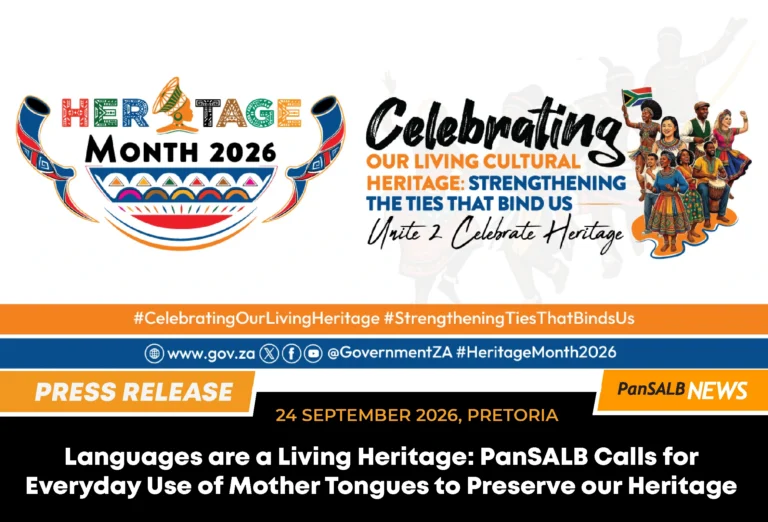
As South Africa observes National Heritage Day (24 September), the Pan South African Language Board (PanSALB) calls on all South Africans to recognise language as one of the most important and enduring expressions of cultural heritage. Our heritage is reflected in our colourful traditional clothing, the food we hold dear and the cultural customs that are deeply embedded in our way of life. Woven through all these cultural expressions is language. For many Africans, language is more than a means of communication. It is about how we interpret and process the world around us. How we introduce ourselves, with izithakazelo, izibongo, diboko, illustrates how we share wisdom passed down from generations, and preserve our proverbs, idioms, songs and histories. Through language, we communicate who we are, where we belong and what we have experienced. When we use our mother tongue, we keep our heritage alive and pass on cultural knowledge and traditions. Most importantly, our languages serve as a bridge connecting generation to generation and serve as a living heritage that allows our family histories and oral traditions to be carried through time.
“Our heritage lives in the words we speak, in our traditions and customs. Therefore, on Heritage Day, we must not only celebrate but actively work towards ensuring that our languages remain relevant for future generations. Parents should take pride in teaching their children their mother tongue, for the loss of a language risks losing the unique worldview and aspects of indigenous knowledge carried by that language. Parents and grandparents play an important role in transmitting language” said PanSALB CEO, Dr Keaobaka Seshoka. PanSALB further calls for South African languages to be used meaningfully across all spheres of society, including homes, schools, the media, public services and digital spaces.
“We must make our languages part of our everyday lives, at home, in our schools, in the media and increasingly in the digital space where most young people communicate. A language cannot develop if it is not used. While English continues to play an important role in our multilingual society, we must ensure that its growing dominance does not come at the expense of our indigenous languages. Heritage cannot be preserved through celebration on one day of the year. It must be sustained through everyday use, we must collectively take on the responsibility to create opportunities for languages to be used in education, technology, business and public life” she added.
As South Africa celebrates its rich and diverse cultural landscape, PanSALB calls on all South Africans to recognise that our languages are not merely tools of communication, but are living repositories of our traditions, histories, identities and knowledge. Therefore, protecting and promoting them is a shared responsibility.